

Supreme Court: High Courts Cannot Re-Appreciate Evidence While Exercising Certiorari Jurisdiction Under Article 226
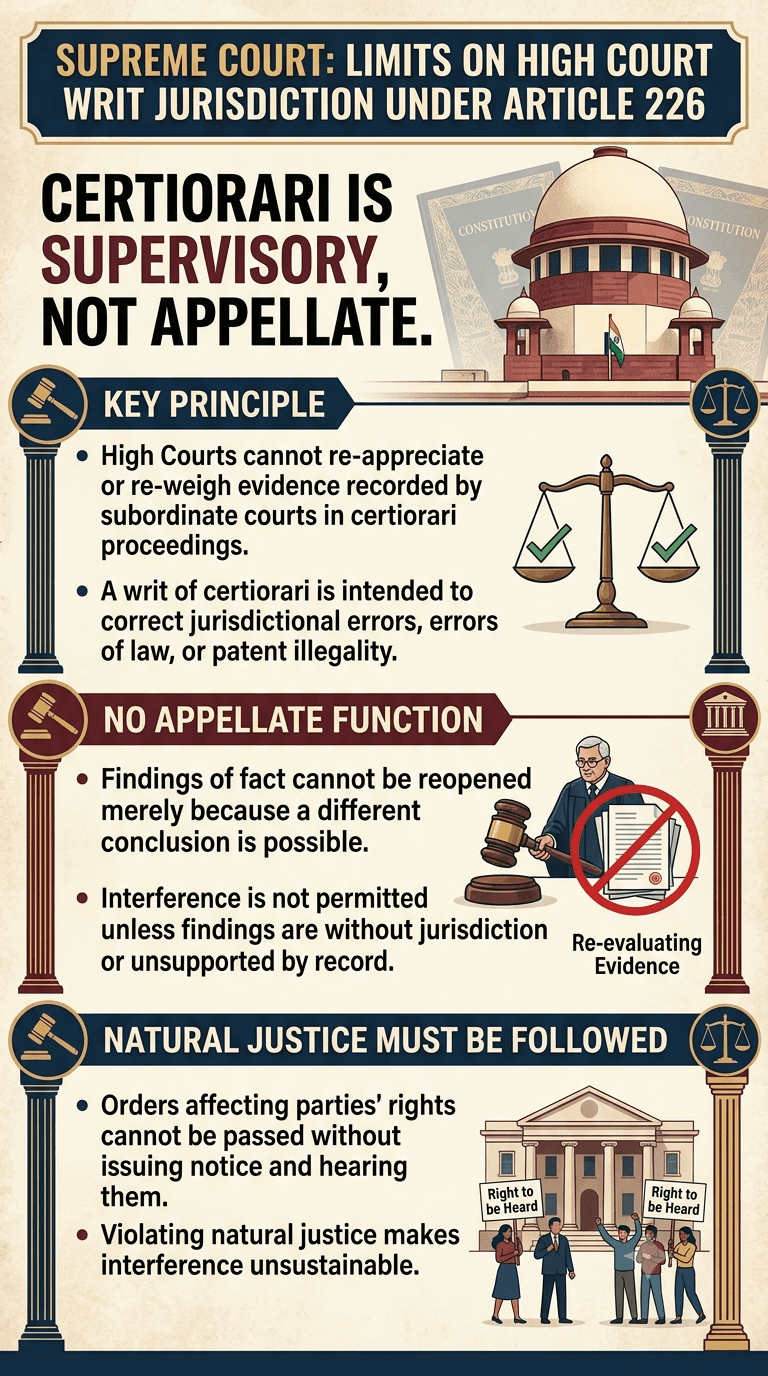
The Supreme Court has reaffirmed that the writ of certiorari is a supervisory remedy and not an appellate jurisdiction. High Courts cannot reweigh or reappreciate evidence recorded by subordinate courts merely because a different conclusion is possible. Interference is permissible only in cases involving jurisdictional error, patent illegality, or an error of law.
Regalius Law Partners3 min read
In a significant ruling reinforcing the limits of the High Court's writ jurisdiction, the Supreme Court has held that a writ of certiorari cannot be invoked to review or reappreciate evidence on the basis of which subordinate courts have arrived at their findings. The Court clarified that the supervisory jurisdiction under Article 226 of the Constitution is intended to correct jurisdictional errors, errors of law, or patent illegality, and not to function as an appellate forum.
The judgment was delivered by a Bench comprising Justice Sanjay Karol and Justice Vipul M. Pancholi, which set aside the Karnataka High Court's decision that had interfered with findings recorded by the First Appellate Court after evaluating the evidence on record.
Background
The dispute arose from a suit for partition that was dismissed by the Trial Court on the ground that the plaintiffs failed to establish their rights over the suit property.
The First Appellate Court affirmed the dismissal of the suit. However, while deciding the appeal, it made certain observations regarding the genuineness of the sale deeds involved in the dispute.
A purchaser, who was aggrieved only by those observations, approached the Karnataka High Court by filing a writ petition challenging that specific portion of the appellate judgment.
The High Court allowed the writ petition and set aside the findings, holding that they were unsupported by the pleadings. Significantly, this relief was granted without issuing notice to certain defendants whose rights were directly affected.
Aggrieved by the High Court's interference, the matter reached the Supreme Court.
Supreme Court's Findings
Allowing the appeal, the Supreme Court held that the High Court had exceeded the permissible limits of its writ jurisdiction.
The Court observed that once the First Appellate Court had considered the pleadings and evidence and rendered findings within its jurisdiction, the High Court could not reassess that evidence merely because another view was possible.
The Bench reiterated that:
The High Court does not exercise appellate jurisdiction while issuing a writ of certiorari.
Findings of fact recorded by subordinate courts cannot be reopened merely to arrive at a different conclusion.
Judicial review under Article 226 is confined to correcting jurisdictional errors, errors of law, or patent illegality.
Reappreciation or reweighing of evidence falls outside the scope of certiorari jurisdiction.
The Court further noted that the findings of the First Appellate Court were based on the evidence adduced during trial and were neither without jurisdiction nor unsupported by the record.
Violation of Principles of Natural Justice
Apart from exceeding its jurisdiction, the Supreme Court also found fault with the High Court for deciding the writ petition without issuing notice to defendants whose rights were directly affected by the order.
The Court held that such an approach violated the principles of natural justice, making the High Court's interference unsustainable.
Decision
The Supreme Court allowed the appeal and restored the judgment of the First Appellate Court, holding that the Karnataka High Court had transgressed the well-settled limits governing the exercise of writ jurisdiction under Article 226.
The ruling serves as an important reminder that the writ of certiorari is a supervisory remedy intended to ensure that courts and tribunals act within the bounds of their jurisdiction. It is not a mechanism for reassessing evidence or substituting factual findings rendered by competent courts.