

Supreme Court Clarifies: “Can” in Arbitration Clause Does Not Create Mandatory Arbitration Agreement
The Supreme Court has ruled that the word “can” in an arbitration clause does not create a mandatory obligation to arbitrate disputes. The judgment reinforces that arbitration must be based on clear mutual consent, making precise contract drafting essential for businesses and commercial agreements.
Regalius Law Partners2 min read
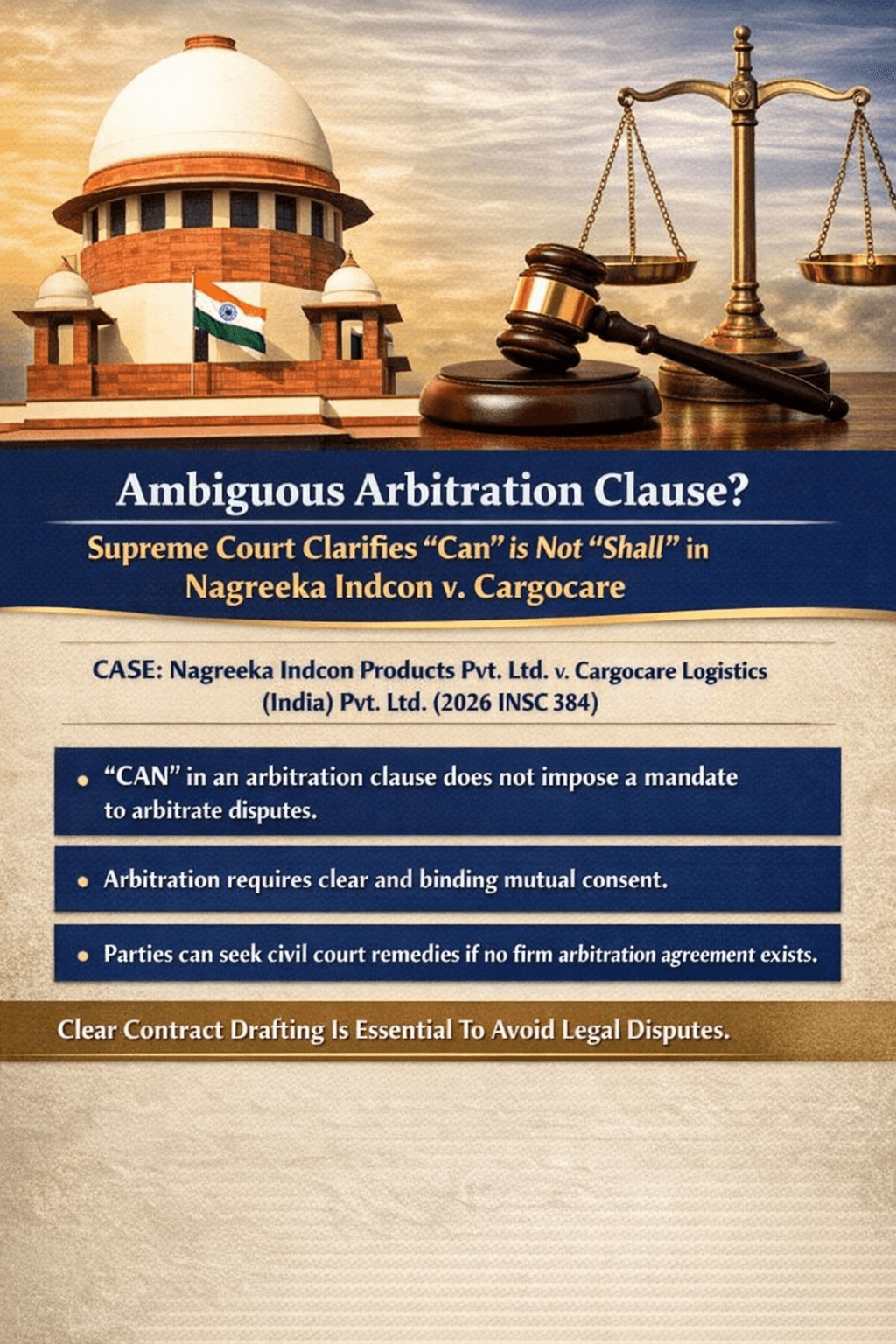
In a noteworthy decision on arbitration law, the Supreme Court of India in Nagreeka Indcon Products Pvt. Ltd. v. Cargocare Logistics (India) Pvt. Ltd. (2026 INSC 384) has clarified that the mere use of the word “can” in a dispute resolution clause does not amount to a binding arbitration agreement. The Court held that such wording only indicates a possibility of arbitration and not a mandatory obligation to refer disputes through that mechanism.
The dispute arose out of a commercial logistics transaction between the parties. Nagreeka Indcon Products Pvt. Ltd., a manufacturer and exporter, had engaged Cargocare Logistics (India) Pvt. Ltd. for transportation of consignments to the United States. Differences emerged when one of the consignments was allegedly delivered without compliance with agreed documentation requirements, leading to financial loss and subsequent claims between the parties.
The contract contained a clause stating that any dispute “can be settled by arbitration” in India or at a mutually agreed place. Relying on this clause, the appellant sought appointment of an arbitrator. However, the respondent opposed the request, contending that arbitration was optional and not compulsory.
Agreeing with the respondent, the Supreme Court observed that arbitration is founded entirely on party consent and cannot be imposed unless the contract clearly reflects a definite and binding intention to arbitrate. The Court noted that words such as “can” or “may” generally indicate discretion or possibility, whereas mandatory expressions like “shall” signify obligation.
Accordingly, the Court held that the clause merely preserved the future possibility of arbitration and would require fresh consent of both parties if arbitration was to be pursued. In the absence of such consent, parties remain free to seek remedies before competent civil courts.
This judgment is a significant reminder for businesses, companies, and contracting parties to carefully draft dispute resolution clauses. Even a single ambiguous word can determine whether parties are required to arbitrate or litigate.
From a broader commercial perspective, the ruling highlights that every word in a contract carries legal significance. A carefully drafted dispute resolution clause can protect business relationships, preserve time and resources, and ensure smoother conflict resolution. In modern commerce, precision in drafting remains one of the strongest tools of legal and commercial risk management.