

Supreme Court Clarifies That Limitation Under Section 34 Begins Only After Disposal of Section 33 Application
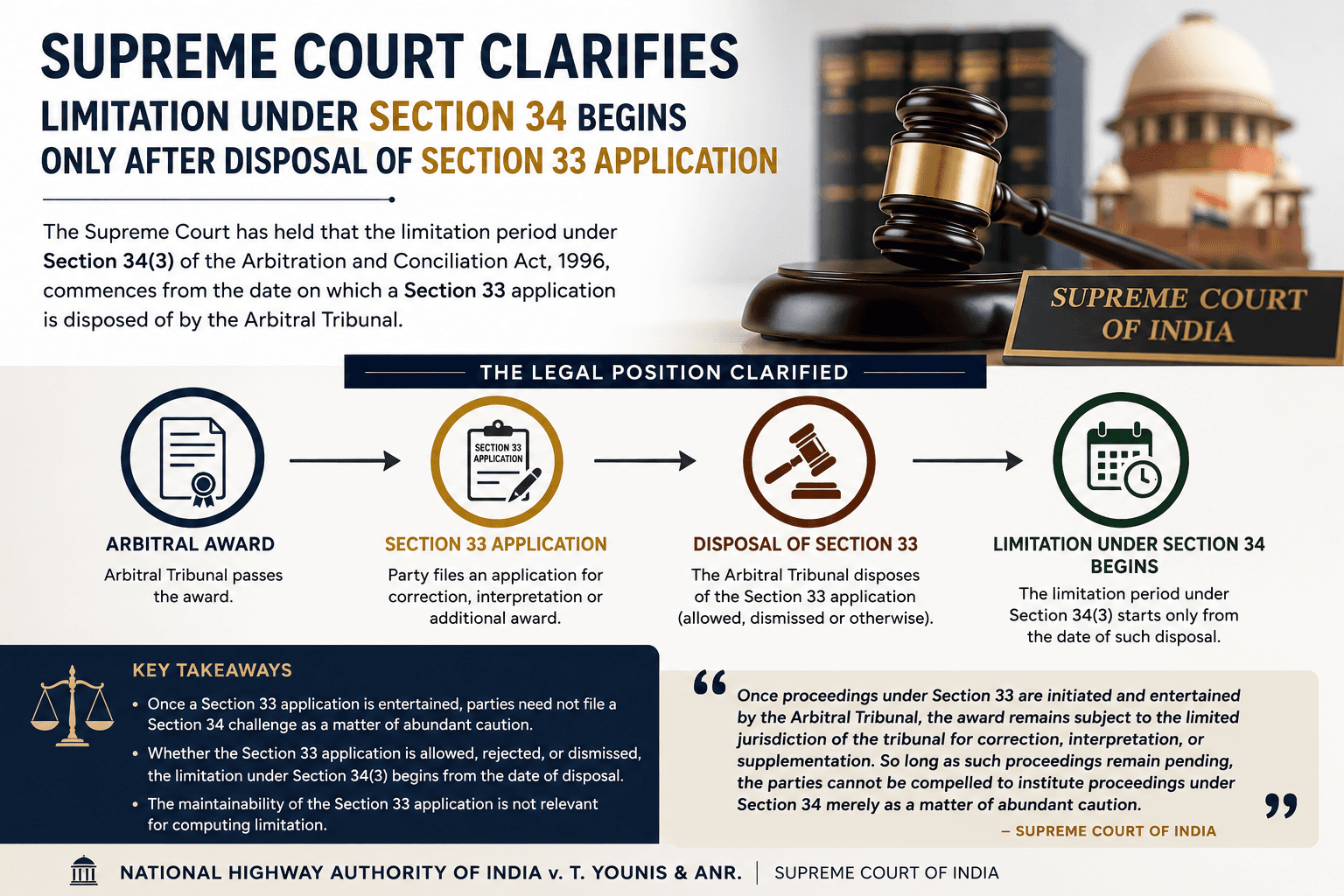
The Supreme Court has clarified that the limitation period for filing a challenge to an arbitral award under Section 34(3) of the Arbitration and Conciliation Act, 1996, begins only upon the disposal of a Section 33 application by the Arbitral Tribunal. The Court held that this principle applies irrespective of whether the Section 33 application is allowed or dismissed, providing important clarity on the computation of limitation in arbitration proceedings.
Regalius Law Partners4 min read
The Supreme Court has reaffirmed an important principle governing arbitral proceedings under the Arbitration and Conciliation Act, 1996. In a recent judgment, the Court held that the limitation period prescribed under Section 34(3) for challenging an arbitral award commences only from the date on which an application filed under Section 33 is disposed of by the Arbitral Tribunal.
The decision came in the case of National Highway Authority of India v. T. Younis & Anr., where the Court clarified the interplay between Sections 33 and 34 of the Arbitration Act and resolved an important question concerning the computation of limitation.
Background of the Dispute
The dispute arose from land acquisition proceedings initiated for a National Highway project in Karnataka's Ballari district. Compensation was initially determined under the National Highways Act, 1956. Dissatisfied with the compensation awarded, the National Highway Authority of India (NHAI) invoked arbitration.
Following a remand by the High Court, the Arbitrator passed an award granting certain statutory benefits available under the Land Acquisition Act, 1894.
Subsequently, NHAI filed an application under Section 33(1)(a) of the Arbitration and Conciliation Act, seeking correction of the arbitral award on the ground that the grant of additional market value and interest was legally unsustainable. The landowner also filed a Section 33 application seeking an additional award. Both applications were ultimately dismissed by the Arbitrator through a common order.
After receiving a certified copy of the order disposing of the Section 33 applications, NHAI filed petitions under Section 34 challenging the arbitral award. While the District Court condoned the delay and entertained the challenge, the Karnataka High Court held that NHAI's Section 33 application was not maintainable and therefore could not extend the limitation period under Section 34(3).
Aggrieved by the decision, NHAI approached the Supreme Court.
Supreme Court's Findings
A Bench comprising Justice Pamidighantam Sri Narasimha and Justice Alok Aradhe set aside the Karnataka High Court's judgment and held that the limitation period under Section 34(3) begins from the date on which the Section 33 application is disposed of, irrespective of whether the application is ultimately allowed or dismissed.
The Court emphasized that once proceedings under Section 33 are initiated and entertained by the Arbitral Tribunal, the award remains subject to the Tribunal's limited jurisdiction for correction, interpretation, or supplementation. During the pendency of such proceedings, parties cannot be expected to simultaneously initiate proceedings under Section 34 merely as a precautionary measure.
According to the Court, the statutory scheme clearly indicates that a party can effectively pursue its remedy under Section 34 only after the conclusion of proceedings under Section 33.
Maintainability of Section 33 Application Not Relevant
One of the principal arguments advanced by the respondents was that only a "maintainable" application under Section 33 could postpone the commencement of limitation under Section 34(3).
Rejecting this contention, the Supreme Court observed that the Arbitration Act does not distinguish between applications that are ultimately allowed, dismissed, or found to be without merit. The relevant consideration is whether the jurisdiction of the Arbitral Tribunal under Section 33 was formally invoked and whether such proceedings remained pending before the Tribunal.
The Court noted that if the legislature intended to restrict the benefit only to successful or maintainable applications, it would have expressly incorporated such a qualification in the statute. Courts cannot read into the provision restrictions that Parliament itself has not chosen to impose.
Significance of the Judgment
This ruling provides much-needed clarity on the computation of limitation under the Arbitration and Conciliation Act. The judgment reinforces the principle that parties should not be compelled to file protective Section 34 petitions while their Section 33 applications are pending consideration.
The decision also promotes procedural certainty and avoids unnecessary litigation by ensuring that parties can first exhaust the limited corrective mechanisms available under Section 33 before resorting to a challenge under Section 34.
For arbitration practitioners, corporations, government authorities, and litigants, the judgment serves as an important precedent confirming that the limitation period for setting aside an arbitral award begins only upon disposal of a Section 33 application, regardless of the outcome of such application.
Conclusion
The Supreme Court's decision in National Highway Authority of India v. T. Younis & Anr. settles an important aspect of arbitration law by holding that once a Section 33 application is entertained by the Arbitral Tribunal, the limitation period under Section 34(3) commences only from the date on which that application is disposed of.
The ruling strengthens procedural fairness in arbitral proceedings and provides clarity on the rights of parties seeking to challenge arbitral awards, thereby contributing to a more predictable and efficient arbitration framework in India.